Father's Three Hands
September 4, 2026 - October 14, 2026
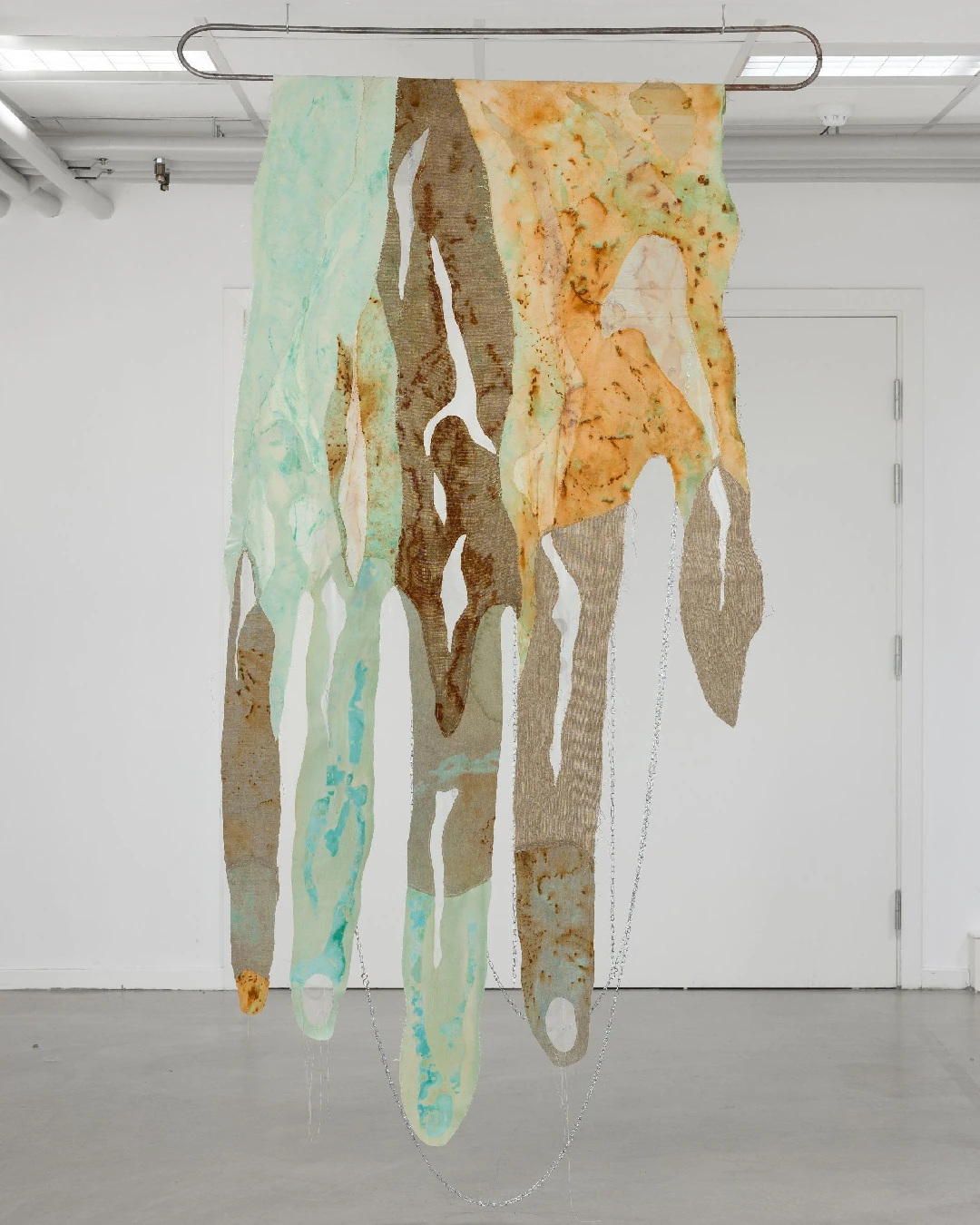
The installation Father’s Three Hands will be unveiled on September 4, 2026, at the exhibition space PUCCS Contemporary in Budapest. The installation Father’s Three Hands revolves around themes of trust, power dynamics, and manipulation, as well as societal imbalances and darker sides. Additionally, the work explores impermanence in both material and organic contexts. The visual expression of the piece draws from human anatomy, with the artist's specific inspiration stemming from educational anatomical charts of hands.
The artwork consists of three free-hanging surfaces sewn together from textiles and shaped like three hands. Measuring 250 cm each, the three pieces are suspended from the ceiling by metal chains.
Father’s Three Hands is crafted from coarse and fine linen, silk, and tulle. The nearly transparent silk and tulle stand in sharp contrast to the rough linen. The textiles have been treated using a graphic technique where patinated copper creates a turquoise print on the fabric. Furthermore, the linen has been colored using metal water and imprint from chains, leaving the material with deep brown shades. The combination of the textile's texture and the metal's patina creates a visual effect that evokes the decay of the body, exposing flesh and bone through the process of decomposition.
The title Father’s Three Hands refers to the Holy Trinity: the Father, the Son, and the Holy Spirit. In this installation, however, the hands take on a different meaning. They do not point toward harmony, but toward a world marked by unrest and inequality. Two of the hands form a pair, while the third stands apart, suggesting something uncontrollable and disruptive. The focus shifts from the divine to the primal and fragile aspects of human nature—the sides we cannot always control, such as violence, betrayal, hidden intentions, and paralysis.
In her practice, Ditte Marie Frost takes her point of departure in the subconscious and the obscured aspects of our world, where everything is in constant flux. Frost works across the mediums of installation, sculpture, and painting, using materials such as oxidized copper, steel, brass, iron, oil paint, and textiles.
In her works, Frost combines sculptural elements made from various metals and textiles. The textiles are bleached and patinated by oxidized metals through a specialized technique. Frost is drawn to the utilization of chemical processes, as they leave an expression in the works that balances between the uncontrollable and the predictable. The patination and corrosion processes used in Frost’s works reflect one of the overarching themes in her practice: impermanence and transformation.
Frost’s motifs draw from insects, weapons, and human and animal bodies. By combining bodily figurations with oxidized metals, she creates a space that oscillates between destruction and creation. For her motifs, Frost finds inspiration in alchemy, religion, and film—particularly genres such as horror, sci-fi, and body horror. In her artistic practice, Frost is furthermore inspired by Julia Kristeva's and Carl Jung's ideas on consciousness.
///
A Mindenható három keze című installáció 2026. szeptember 4-től látható a PUCCS Contemporary kiállítóterében. A mű a bizalom, a hatalmi viszonyok és a manipuláció témáit, valamint a társadalmi egyenlőtlenségeket és azok sötétebb oldalait járja körül. Vizsgálja továbbá a mulandóságot anyagi és organikus kontextusban egyaránt. Az installáció vizualitása az emberi anatómiából merít, a konkrét inspirációt pedig a kezekről készült oktatási célú anatómiai ábrák adták.
A műalkotás három, textilekből összevarrt, a mennyezetről fémláncokon lógó felületből áll, amelyek három kéz alakját formázzák.
A „Mindenható három keze” durva vásznakból, finom selyemből és átlátszó tüllből készült. A textíliák oxidált rézoldatos kezelés során sajátos türkizkék mintázatot kaptak, valamint további fémoldatos színezés során mélybarna árnyalatokkal gazdagodtak. A textília textúrája és a fém patinája együttesen olyan vizuális hatást kelt, amely a test bomlását idézi fel, a bomlási folyamat során felfedve a húst és a csontot.
Az installáció címe a Szentháromságra utal: az Atyára, a Fiúra és a Szentlélekre. Ebben az installációban azonban a kezek más jelentést nyernek. Nem a harmóniát testesítik meg, hanem egy nyugtalan és egyenlőtlen világot. Két kéz párban van, míg a harmadik elkülönül tőlük, utalva valami ellenőrizhetetlenre és zavaróra. A hangsúly az isteni jellegről az emberi természet ősi és törékeny mivoltára helyeződik át – azokra a dolgokra, amelyeket nem mindig tudunk kézben tartani, úgy, mint az erőszak, az árulás, a rejtett szándékok és a tehetetlenség.
Ditte Marie Frost alkotói gyakorlatában a folytonosan változó tudatalattiból és rejtett világunkból indul ki. Installációiban, szobrászati és a festészeti munkáiban olyan anyagokkal dolgozik, mint az oxidált réz, a sárgaréz, az acél, a vas, az olajfesték, valamint különböző textíliák.
Előszeretettel alkalmaz kémiai eljárásokat az alkotás során, amellyel egyensúlyt teremt a kontrollálhatatlan és a kiszámítható között. A beépülő patinázási és korróziós folyamatok tükrözik a művész alkotói gyakorlatának egyik átfogó témáját: a mulandóságot és az átalakulást.
Frost motívumai rovarokból, fegyverekből, valamint emberi és állati testekből merítenek. A testábrázolások és az oxidált fémek integrálásával olyan teret hoz létre, amely a pusztítás és a teremtés között ingadozik. Motívumaihoz az alkímiából, a vallásból és a filmekből merít ihletet – különösen olyan műfajokból, mint a horror, a sci-fi és a body horror. Művészi gyakorlatát Julia Kristeva és Carl Jung tudatosságról szóló gondolatai is inspirálják.
On view 0-24h
Organized by Parallel Art Foundation
Curator: Gábor Pintér
Supported by Hungarian Academy of Arts, Statens Kunstfond (Danish Arts Foundation), Kulturudviklingspuljen (Cultural Development Fund - Aarhus)
http://www.parallelfoundation.com